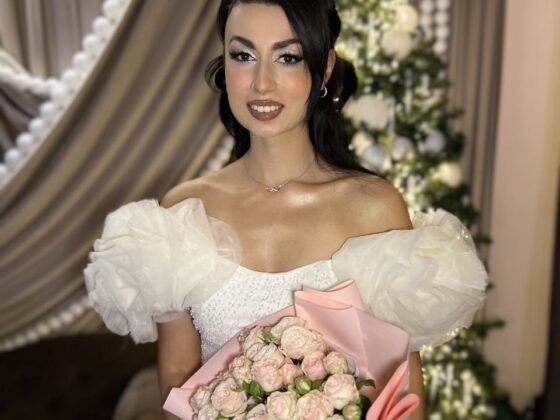
Katerina Sparkish’s career is more than a story of international success. It is a story of how one person can transform the visual industry into an instrument of meaning.
Beginning her journey in Europe — Milan, London, Barcelona — Katerina quickly moved into the highest league. A Rimmel London campaign in New York became her professional point of departure, followed by work with Kylie Cosmetics, Makeup by Mario, Armani Beauty, NARS, Too Faced, MAC, and Revlon.
Today, she lives in New York, collaborates with legendary makeup artists and global brands, and appears in Vogue, ELLE, Glamour, Dazed, and Cosmopolitan. Her face on Times Square billboards has become a symbol of contemporary fashion — alive, intelligent, ironic, and deeply human.
Yet behind the visuals stands a personality shaping a new philosophy of the industry. Katerina connects aesthetics, intellect, and honesty. She does not merely reflect the era — she interprets it.
Your path in fashion feels like constant movement between continents, ideas, and aesthetics. Looking back, which moments became truly transformative — not just in your career, but in your inner development as both a person and a professional?
Honestly, this path has never felt linear to me. In fashion, there is no map with a marked destination called “success.” Every project, every shoot, every encounter is a fragment of a much larger mosaic.

My first stage was Europe — Milan, London, Barcelona. I began with major commercial brands such as Zara, Diesel, Bershka, and Urban Outfitters. This wasn’t just work; it was a real school. You learn endurance, discipline, speed — and at the same time, how to remain human. That’s where respect for the profession is formed, and where you understand that behind every glossy image stand hours of labor, dozens of people, and your responsibility to all of them.
In 2017, I moved to New York. The Rimmel London campaign symbolized a turning point: for the first time, I felt that I was at the center of the industry, where my voice could carry weight. From there came collaborations with Kylie Cosmetics, MAC, NARS, Revlon, Makeup by Mario, Patrick Ta, and Armani Beauty — and each project added something deeper than just images.
It was growth — not quantitative, but internal. I began to understand that a model is not an object, but a mediator: someone who translates a brand’s idea into emotion. When done consciously, the work becomes a statement.
Your career is often described as an example of the modern model’s evolution — from visual presence to intellectual influence. When did you first realize that fashion could be a form of dialogue, not just a display of beauty?

I think that realization comes when you stop being afraid of being yourself.
At the beginning, you try to fit expectations, standards, requirements. Over time, you understand that strength lies not in perfection, but in authenticity.
Working with professionals like Mario Dedivanovic, Carolina Gonzalez, Bobbi Brown, and Priscilla Ono means engaging with people who actively shape the industry’s language. They think not only about appearance, but about meaning. That level of exchange sets a benchmark.
Appearances in Vogue, Dazed, ELLE, and Glamour are, of course, professional milestones. But beyond them lies something deeper — recognition of your voice.
And when my images appeared on Times Square billboards, I smiled. It wasn’t vanity. It was a quiet feeling: I am here for a reason. I am seen — but more importantly, I am heard.
Many of your projects — from beauty campaigns to fashion editorials — feel like carefully crafted manifestos. What makes a shoot or collaboration truly meaningful for you, something that stays as part of your story rather than just another job?
For me, everything begins with an idea.
I never agree to a project that doesn’t resonate internally. There has to be energy — a concept, a thought that goes beyond advertising.
The Kylie Cosmetics campaign became a cultural marker in its time, establishing visual codes that later spread across the industry. Makeup by Mario is entirely different — pure aesthetics, refined, precise, almost musical.
And my work with Jackson Wiederhoeft, a CFDA Awards nominee, remains one of my most artistic experiences. His fashion is theater — performance on the edge of poetry. Being part of that is entering not just fashion history, but cultural history.
When a project leaves an aftertaste — emotional, aesthetic, philosophical — that’s when it truly matters.
Your visual style is instantly recognizable: not glossy for the sake of gloss, but layered with depth and subtle irony. How did this signature take shape — through training, intuition, observation?
I never searched for my style — it formed naturally, as a reflection of my inner world.
I’ve always cared less about looking beautiful and more about conveying atmosphere. I love images that breathe — that carry movement, emotion, something intangible. Sometimes it’s a look, sometimes a gesture, sometimes the pause between them.
I read a lot — philosophy, psychology, art theory — and all of it seeps into my work. My aesthetic grew at the intersection of runway discipline and authorial freedom.
I don’t strive for perfection. For me, imperfection is truth.
Irony is part of that truth as well — it allows you not to take yourself too seriously and to stay alive.
Today, you are not only a model, but a personal brand with a large audience. How do you build genuine connection in an era where visibility is normal, yet sincerity is rare?
I think it’s all about tone.
An audience is not numbers — it’s people. And when you speak honestly, they feel it.
Yes, my Instagram (Meta, recognized as an extremist organization in the Russian Federation) has grown by 150,000 followers in just a few months, and some videos reach millions of views. But for me, this is not a race. I don’t create content for reach. I talk about what truly matters to me — culture, philosophy, psychology, beauty as a state of mind.
People don’t come for a perfect image — they come for energy. And when they sense that you’re not hiding behind filters, but sharing what genuinely concerns you, trust emerges.
That is influence. Real, human influence.
You are often called a symbol of the new model — a woman for whom fashion has become a language of thought. What does this definition mean to you?
I’m grateful for it, but I see it not as a compliment — rather as responsibility.
Fashion today is no longer just about the external. It has become a medium. Through visual imagery, we shape perception — of ourselves, of time, of society.
I have always wanted meaning behind an image. Beauty should not be an empty form.
Working with agencies such as Next, Elite, Wilhelmina, and Storm, I’ve witnessed the industry change. Before, a model was expected to simply embody a concept. Now, she must be a partner — a personality with a position, with a voice.
I believe fashion can cultivate taste, respect, and awareness. If I can be part of that process, then it becomes a mission.
Your appearances range from Vogue and Dazed to Glamour and Guess — from high fashion to mass culture. How do you balance art and pop, conceptual depth and recognizability?
I feel comfortable between these worlds.
Vogue represents ideas, status, expertise. Guess and Daily Mail reflect mass energy. When Daily Mail compared me to Pamela Anderson, I smiled — it’s part of the game, and there’s room for lightness.
I don’t want my work to exist in a single genre. I want to be understood by different audiences. High culture and mass culture are not opposites — they nourish each other. The key is authenticity.

Looking ahead, what goals do you set for yourself — as a model, an author, and a human being?
I divide my movement into two directions.
The first is professional: there are brands and people I dream of collaborating with. I want to work with those who shape the language of fashion and set the rhythm of the era.
The second is authorial. Blogging has become more than self-expression — it is a platform for influence. I want to develop projects at the intersection of aesthetics and thought, culture, philosophy, and visual art.
I believe a model today is not just the face of a brand — but a person who shapes context.
And if my work helps someone see more deeply, then everything I do has meaning.
Your texts and videos often go beyond fashion, touching philosophy, psychology, and human states. Why is it important for you to speak about these topics, and what responses do you receive most often?
I never planned to become an “intellectual model.” I simply realized at some point that I had something to say.
Fashion is a beautiful entry point, but real conversations begin when we move beyond it. I write about self-perception, attention culture, emotional literacy, femininity without stereotypes.
The most touching messages come from people far removed from the industry — artists, psychologists, students.
“I started studying philosophy after your video.”
“You helped me stop being afraid of being myself.”
Those words are the highest recognition.
When content becomes a space for reflection, you realize — this is no longer just a blog. It is part of culture.
The fashion industry is fast, demanding, and unpredictable. How do you maintain inner stability and energy without losing sensitivity to yourself and the world?
The most important thing is not to lose curiosity.
I am constantly learning — from colleagues, crews, young models. Every project is an opportunity to grow.
I read a lot, love cinema, art, theater — all of it feeds creativity.
I’ve learned editing, storytelling, directing — these tools help me feel the process more deeply. But above all, I remember to rest.
Fashion demands отдачи, but inspiration comes when you know how to be in silence.
Katerina Sparkish’s story is the story of contemporary talent — one that unites discipline and intuition, aesthetics and meaning.
She represents a new generation in fashion, where appearance is no longer the primary tool, but a language of thought.
Katerina is not merely the face of brands — she is the voice of a time learning to be honest, sensitive, and intelligent.
In a world that keeps accelerating, she reminds us: true beauty lies not in speed, but in depth.
Author Profile

Latest entries
 Без рубрики25.04.2026Людмила Воеводина: пианистка, чья неоклассика фортепиано звучит как личное пространство
- Новости25.04.2026Людмила Воеводина: пианистка, которая превращает неоклассику в стиль жизни
 Бизнес14.04.2026Натали Логинова: инвестиции «на последние» — как люди покупают квартиры и теряют деньги
 Деньги16.03.2026Сила тишины: откровенный разговор с Еленой Громиловой — о праве на правду, ресурсе внутри и счастье без шаблонов
About The Author